
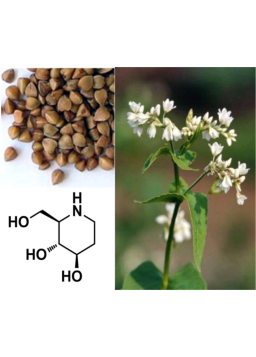
A nature-based proposal from an ancient grain  D-Fagomine is a non-digestible glucose analog. It was discovered and
first isolated from buckwheat in 1974 but it was not until a few years
ago when started doing tests on
its biological activity, and then
understand its functionalities.
Buckwheat contains a number of
relevant active substances and
only recent research has shown
that the D-fagomine presence in
buckwheat is behind much of the
healthy benefits related
traditionally to buckwheat food
consumption.
D-Fagomine is a friendly Secon-
dary Metabolite witch is specially beneficial for the the plant. This
metabolite protects the grain by inhibiting competitively third parties
glycosidases and giving an advantage to the buckwheat grain to stay
whole longer. In human diet, D-fagomine has been shown to decrease
postprandrial blood glucose level without stimulating insulin secretion.
As such D-fagomine has been proposed as a useful dietary ingredient or
functional food component to reduce the health risks associated with an
excessive intake of fast-digestible carbohydrates.
The most recent research on the substance is showing aditional sinergic
molecular mechanisms of D-fagomine activating the immune cells and
modulate microbiome, encouraging the growth of some beneficial
species by reducing the presence of agressive sugar hungry species.
D-fagomine research represents nowadays one of the most innovative
areas of development in nutrition to get and mantain a healthy
microbiome that might be easily translated to the market because of its
presence in the human food chain. Also the research on this dietary
substance are opening novel scientific ways to overcome some of the
immune-mediated inflammatory diseases (autoimmune diseases) that
are very prevalent nowadays.
Healthy Traditional Food
There is a positive feeling of healthy food linked to buckwheat. This
grain is usually related to an historical consumption in times of famine,
keeping people healthy. It is present in almost all the countries in the
North Hemisphere where this grain grows spontaneously in clearings of
the forest, and where it has been also cultivated for centuries.
Many traditional foods are based on this healthy grain. Buckwheat is
used to prepare different foodstuffs such as noodles (Japanese soba,
Korean makguksu, or Italian pizzoccheri), groats (Polish Kasha),
pancakes (French crêpes de Bretagne, Slavic blinis, or North American
ployes), boiled flour (Italian polenta or Slovenian and Croatian žganci),
fried dough (Spanish farinetes de fajol from Catalonia), beer, biscuits or
cookies, bread and a myriad of other healthy home recipes.
D-Fagomine is a non-digestible glucose analog. It was discovered and
first isolated from buckwheat in 1974 but it was not until a few years
ago when started doing tests on
its biological activity, and then
understand its functionalities.
Buckwheat contains a number of
relevant active substances and
only recent research has shown
that the D-fagomine presence in
buckwheat is behind much of the
healthy benefits related
traditionally to buckwheat food
consumption.
D-Fagomine is a friendly Secon-
dary Metabolite witch is specially beneficial for the the plant. This
metabolite protects the grain by inhibiting competitively third parties
glycosidases and giving an advantage to the buckwheat grain to stay
whole longer. In human diet, D-fagomine has been shown to decrease
postprandrial blood glucose level without stimulating insulin secretion.
As such D-fagomine has been proposed as a useful dietary ingredient or
functional food component to reduce the health risks associated with an
excessive intake of fast-digestible carbohydrates.
The most recent research on the substance is showing aditional sinergic
molecular mechanisms of D-fagomine activating the immune cells and
modulate microbiome, encouraging the growth of some beneficial
species by reducing the presence of agressive sugar hungry species.
D-fagomine research represents nowadays one of the most innovative
areas of development in nutrition to get and mantain a healthy
microbiome that might be easily translated to the market because of its
presence in the human food chain. Also the research on this dietary
substance are opening novel scientific ways to overcome some of the
immune-mediated inflammatory diseases (autoimmune diseases) that
are very prevalent nowadays.
Healthy Traditional Food
There is a positive feeling of healthy food linked to buckwheat. This
grain is usually related to an historical consumption in times of famine,
keeping people healthy. It is present in almost all the countries in the
North Hemisphere where this grain grows spontaneously in clearings of
the forest, and where it has been also cultivated for centuries.
Many traditional foods are based on this healthy grain. Buckwheat is
used to prepare different foodstuffs such as noodles (Japanese soba,
Korean makguksu, or Italian pizzoccheri), groats (Polish Kasha),
pancakes (French crêpes de Bretagne, Slavic blinis, or North American
ployes), boiled flour (Italian polenta or Slovenian and Croatian žganci),
fried dough (Spanish farinetes de fajol from Catalonia), beer, biscuits or
cookies, bread and a myriad of other healthy home recipes.
 Contact us !!!
We are walking the way to improve the awareness
of D-fagomine nutritional benefits to the nutritional
society and also to the food & health players.
If you are a health professional, nutrition expert
from Industry, Academia or Administration we invite
you to contact us to be updated on the technical
advances and to discuss the way we can cooperate
to accelerate the communication and launch into
the market of novel proposals based on the present
knowledge and available intelectual property.
Contact us !!!
We are walking the way to improve the awareness
of D-fagomine nutritional benefits to the nutritional
society and also to the food & health players.
If you are a health professional, nutrition expert
from Industry, Academia or Administration we invite
you to contact us to be updated on the technical
advances and to discuss the way we can cooperate
to accelerate the communication and launch into
the market of novel proposals based on the present
knowledge and available intelectual property.

 @
@
D-Fagomine is a non-digestible glucose analog. It was discovered and
first isolated from buckwheat in 1974 but it was not until a few years
ago when started doing tests on
its biological activity, and then
understand its functionalities.
Buckwheat contains a number of
relevant active substances and
only recent research has shown
that the D-fagomine presence in
buckwheat is behind much of the
healthy benefits related
traditionally to buckwheat food
consumption.
D-Fagomine is a friendly Secon-
dary Metabolite witch is specially beneficial for the the plant. This
metabolite protects the grain by inhibiting competitively third parties
glycosidases and giving an advantage to the buckwheat grain to stay
whole longer. In human diet, D-fagomine has been shown to decrease
postprandrial blood glucose level without stimulating insulin secretion.
As such D-fagomine has been proposed as a useful dietary ingredient or
functional food component to reduce the health risks associated with an
excessive intake of fast-digestible carbohydrates.
The most recent research on the substance is showing aditional sinergic
molecular mechanisms of D-fagomine activating the immune cells and
modulate microbiome, encouraging the growth of some beneficial
species by reducing the presence of agressive sugar hungry species.
D-fagomine research represents nowadays one of the most innovative
areas of development in nutrition to get and mantain a healthy
microbiome that might be easily translated to the market because of its
presence in the human food chain. Also the research on this dietary
substance are opening novel scientific ways to overcome some of the
immune-mediated inflammatory diseases (autoimmune diseases) that
are very prevalent nowadays.
Healthy Traditional Food
There is a positive feeling of healthy food linked to buckwheat. This
grain is usually related to an historical consumption in times of famine,
keeping people healthy. It is present in almost all the countries in the
North Hemisphere where this grain grows spontaneously in clearings of
the forest, and where it has been also cultivated for centuries.
Many traditional foods are based on this healthy grain. Buckwheat is
used to prepare different foodstuffs such as noodles (Japanese soba,
Korean makguksu, or Italian pizzoccheri), groats (Polish Kasha),
pancakes (French crêpes de Bretagne, Slavic blinis, or North American
ployes), boiled flour (Italian polenta or Slovenian and Croatian žganci),
fried dough (Spanish farinetes de fajol from Catalonia), beer, biscuits or
cookies, bread and a myriad of other healthy home recipes.
Contact us !!!
We are walking the way to improve the awareness
of D-fagomine nutritional benefits to the nutritional
society and also to the food & health players.
If you are a health professional, nutrition expert
from Industry, Academia or Administration we invite
you to contact us to be updated on the technical
advances and to discuss the way we can cooperate
to accelerate the communication and launch into
the market of novel proposals based on the present
knowledge and available intelectual property.
 @
@